
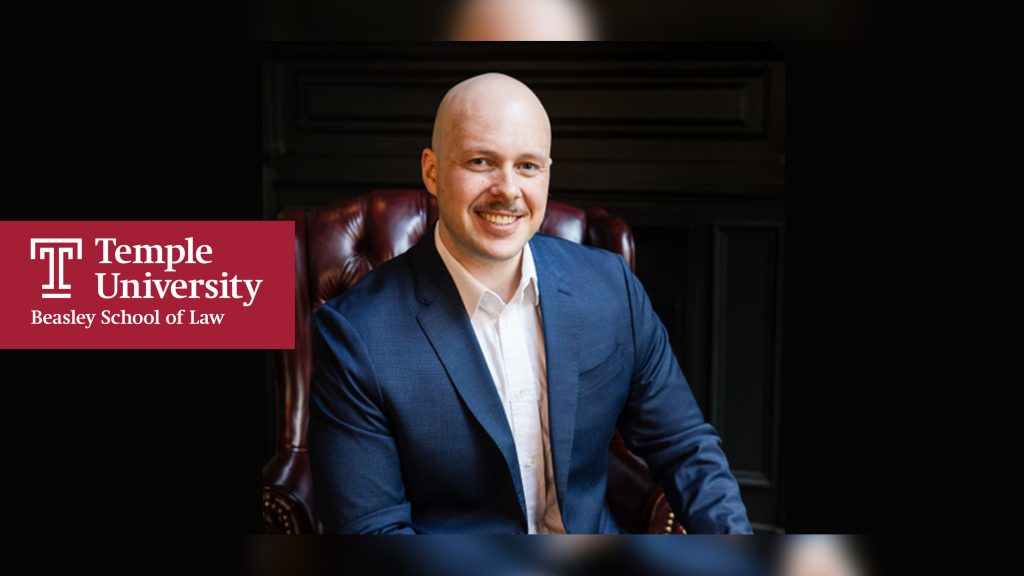
Samuel Parrott (he/him/his)
Hometown: Eldersburg, MD
Education: University of Maryland, College Park (mechanical engineering)
Job: The Belles Group, P.C. (incoming associate, patent law)
Program: Evening
What motivated you to pursue a career in law?
Before law school, I worked as an engineer in commercial construction. My job was to quantify and track project timelines and costs. Our clients often used my analyses to defend against liability or to advocate for entitlements under the project’s contracts. This process sparked my curiosity about combining my technical background with a legal education. That curiosity came to a head when a project I was working on became bottlenecked by a series of contract disputes, and I found myself repeatedly called on to defend and explain my analyses to the client, the owner, and their counsel. That experience was what pushed me to apply to law school. Despite entering law school with an idea of what I wanted to do with my legal education, I remained open to new ideas and possibilities. Regardless, I knew I wanted to build on the technical foundation I’d already spent years developing.
What experiential learning experiences (clinics, internships, trials teams, affinity groups, etc.) did you participate in, and how did they contribute to your legal education?
During my four years as an evening student, I had the opportunity to serve as a judicial intern for the Honorable Judge Tsai in the Philadelphia Orphans’ Court, to be a summer associate at The Belles Group, P.C., and to be an extern at the University of Pennsylvania Office of General Counsel. Each experience pushed me to become a better writer and, more importantly, gave me a diverse perspective on the career paths available after law school. In my third year, I competed on the Intellectual Property Moot Court Team. The experience was genuinely rewarding, and I recommend it to any student who has the opportunity. In addition to producing a technical writing piece that became an important writing sample, I developed invaluable oral argument skills. The competition problem also involved a practical application of civil procedure principles that supplemented my classroom experience and prepared me for the bar.
What participation and leadership positions did you hold, and how did that shape your law school experience?
During all four years, I was the Evening Division Vice President of the Student Bar Association. The experience helped me better understand my classmates as we all worked through the challenges of navigating law school and the start of a new career. Further, it allowed me to network with far more peers than I could have by attending classes alone.
Which faculty members influenced you the most, and how?
Dean Donald Harris had a particularly significant influence on my education and ultimately my career trajectory. He was the first professor to recommend that I look into patent law, a recommendation that led to my primary focus in law school. The following year, when Intro to Intellectual Property, the prerequisite for all patent and IP courses, wasn’t offered in the evening, Dean Harris supervised a guided research course so I could fulfill the requirement. In my final year, Dean Harris was my faculty advisor for my externship with the University of Pennsylvania Office of General Counsel. I am deeply grateful to him for his support of me and his dedication to the law school. Professor Amy Sinden made me a better writer and thinker. Her Climate Change Law and Policy class covered incredibly important material that challenged students to confront the difficult realities of climate change and administrative policy. Furthermore, her feedback system allowed me to develop my writing in a way that rivaled any other class or learning experience.
What advice would you give to current or prospective Temple Law students?
Start your outline earlier. I heard this advice often and still had a hard time following it. The semester is going to be very busy, and keeping up with weekly assignments is already hard enough. However, finding an hour or so each week to distill the week’s lessons into a running outline pays off significantly by finals. Use your outline to review practice problems during reading week, rather than spending the whole time preparing it.
Do you have any networking advice for current or prospective students?
Start with your classmates. Build a group of friends that you can lean on for support, and offer your support often. These are the relationships that will carry beyond law school. They are also the relationships that will help you navigate the stress and uncertainty of networking with professionals. Send friends job postings for positions you know they’re interested in, remind them of important deadlines, recommend them to employers, invite them to attend networking events. The same will come back to you. Lastly, utilize the Career Services resources through the law school. They are extremely helpful, and the OCI program makes applying for internships much easier.
What challenges do you see facing the legal profession today and in the near future?
The role AI will play in the legal profession is uncertain and at times concerning. As a tool, AI is remarkably useful, and I believe it will become a common part of a lawyer’s toolbox. However, I worry that reliance on the technology may give rise to complacency and unchecked errors. While industry regulation continues to evolve, I expect lawyers and firms will need to proceed cautiously to find the right balance of efficiency and quality
What are some ‘can’t miss’ opportunities at Temple Law?
After 1L, take classes in areas that interest you, even if they don’t align with your career plan. Temple offers a diverse range of courses, many taught by adjunct professors who are active professionals in their fields. The opportunity to fully immerse yourself in a new topic for 14 weeks will broaden your perspective on the options available in the legal career and may uncover a passion or career path you hadn’t considered. Engage with the resources coordinated and offered by the law school, read the email blasts, attend talks by guest lecturers, and schedule appointments with career services. Each new experience can open a door you weren’t expecting. There are so many opportunities to connect with fellow students and faculty, and each connection will give rise to another.
How did you balance law school with your personal life and responsibilities?
Rely on your support systems. There will be an adjustment period at the beginning of 1L while you figure out your routine. Once you’re comfortable with how much time you will need each week to complete your assignments, communicate with your support system and safeguard your time. From there, adjustments will come as you adapt to the workload and become more efficient. Prioritize breaks and carve out time for yourself each week. By the end of law school, the routine will feel like second nature.
What do you wish you had known before starting law school?
Prioritize finishing the readings over taking detailed notes. When I started 1L, I felt like I had to write and remember every detail of a case. That approach meant there was more material than I could get through each week. Knowing what details to look for and focus on is a skill that will come with practice, but let the review of the cases in class be a guide as you get started. You can always go back and review specific details after class. Be comfortable with there not being a single correct answer.