
Today, the Social Justice Lawyering Clinic (SJLC) publishes In the Shadow of the Valley: The Unnecessary Confinement and Dehumanizing Conditions of People in Immigration Detention at Moshannon Valley Processing Center. This report is the first to comprehensively investigate conditions at Moshannon, the largest facility in the Northeast that detains immigrants who are awaiting the processing of their deportation cases. It is written by Cristina Isabel de Arana (’24), Alex Leone (‘25), and Bianca Taipe (’25), law students in the SJLC.
The report is based on interviews conducted by a coalition of community-based organizations, law school clinics, and legal nonprofits who made site visits to the newly opened detention facility in Centre County, Pennsylvania in 2023. People who are detained at Moshannon are being held under punitive, inhumane, and dangerous conditions. They have tightly controlled schedules, live in a “pod” with 60-70 other people, wear brightly colored jumpsuits, and are restricted from accessing the outside world. Further, people at Moshannon have reported issues ranging from the inability to get medical care to physical and psychological abuse by staff. Despite Moshannon’s “conversion” into an immigration detention facility, it operates more like the former federal prison that it once was.
Immigration detention facilities like Moshannon, which cost millions of dollars per month to operate, have not created a fairer, safer, or more efficient immigration system. Instead, detaining immigrants is contrary to this country’s ideals of fairness, freedom, and opportunity. Rather than piecemeal reforms for an already broken system, the government needs to consider alternatives, such as community-based case management systems that can work with people to screen, process, and ensure their attendance at immigration court. For this reason, the report calls for the closure of Moshannon.
See news coverage of the report on WHYY, States’ Newsroom, and Telemundo.
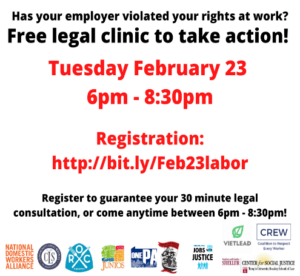 In December, CREW held their first Zoom legal clinic. I worked to organize students to help with intake. The goal of the clinic was to both educate workers and ensure enforcement against employers who are violating the laws. Before the clinic, OnePA and Community Legal Services led trainings to teach us specifically about Philadelphia’s worker protection laws and how to work with potential clients coming from CREW’s member organizations. The clinic Zoom was set up such that organizers from CREW held Know-Your-Rights trainings in the main room, while the law students and other organizers met with workers individually in breakout rooms. Volunteer lawyers were available to field questions from the individual meetings and plan out next steps.