
We teach in classrooms and mock trial courtrooms, talking to and sometimes with our students and then making them speak and demonstrate skills. But I suspect that many of us don’t have the time in our syllabuses to add a “let’s go to court” requirement. Some recent research suggests that we should.
But before we go there, let’s remember where we have done something similar. How many of us have had a “take your child to work” experience? [Mine involved bringing my pre-teen son to observe a federal criminal trial where Mafia members were being prosecuted and where I ended up having him seated with some of the defendants’ family members, resulting in some too-colorful stories.] But we felt something was gained with those activities – we “shared” our lives with our children and made them more familiar with what we do and how it impacts others and ourselves.
The idea of “shared experience” as a teaching/educational tool is more than a decade old. Shteynberg, G., and E. P. Apfelbaum. “The Power of Shared Experience: Simultaneous Observation With Similar Others Facilitates Social Learning.” Social Psychological and Personality Science 4, no. 6 (March 5, 2013): 738–744. The paper explained that
individuals’ cognitive resources are particularly likely to be devoted to information that is co-attended with their group members…Research indicates that, beginning as early as 4 months of age, objects that are jointly attended to by infants and their caregivers are more deeply encoded and are better recognized than are objects that infants attend to alone…
After conducting experiments, the authors confirmed this and concluded that
our results support the general notion that contexts characterized by shared ingroup attention are particularly conducive to social learning. Specifically, we demonstrated that shared observation with a similar other heightened subsequent imitation of the observed written exchange.
Id. The “similar other” referred to is a peer [fellow/sister student].
Move forward to 2025. A law librarian tested this by having students in a legal research course attend a state Supreme Court argument. Tracey McCormick, Watching from the Bench: Exploring Shared Experience (SE) in the Legal Research Classroom. ssrn-5366444.pdf
The librarian illustrated the way shared experience learning impacts the brain:
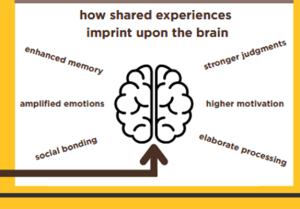
And the student response? Again, the poster presentation shows the outcomes:
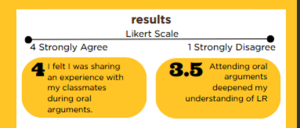
So, does this go beyond the Legal Research classroom to advocacy courses – Moot, Trial Ad and DR? To get answers I wrote Ms. McCormick, a librarian at the University of Wyoming and someone with multiple degrees, including a Masters in Psychology and Education, and posed the following questions:
- How far along is the research on this form of learning?
- Your poster shows the student belief that the experience improved learning and understanding. Has that been tested (e.g. against a control group) to see if the effect is found in the classroom?
Shteynberg and others have tested the effects of “shared experience” in savoring chocolate, using online chat functions, viewing advertisements, mood manipulation, goal pursuit, judgment, and behavioral learning. References to Shteynberg’s “shared experience” show up in literature reviews across a variety of academic domains—psychology, medical and health education, computer science, organizational science, teacher education, English language learning, instructional design, remote learning—the list continues. It does not appear that anyone, in any discipline, has tested the hypothesized positive learning impacts of shared experience in the classroom against a control group. I sense a challenge!
- Would/should it apply to skills courses such as Trial Advocacy, Appellate Advocacy and Mediation/Arbitration?
Shteynberg references social learning theorists Bandura (1977) and Vygotsky (1978) in his research. Learning historically, evolutionarily, has been social. Why not leverage relevant learning, experiential learning, and the shared experience of social learning for more positive outcomes? Why not layer the intellectual endeavor with a social experience? Let’s capitalize on the possibility of creating a positively, emotionally charged learning event and turning it into a core memory, vis-a-vis the movie Inside Out?
- Please explain if this has to be an in-person shared experience or if it can be an online shared experience?
Shteynberg used online conditions to test his hypotheses around shared attention and shared experience, so the research base has already been established. For those seeking to create shared experiences, here’s a quick checklist:
- Co-attention with others to a single object or event is paramount.
- Co-attendees must be aware or believe they are sharing an experience with others during the event.
- A sense of “we” must emerge from attendance at the event: “we” attended, not “I” and others were there.
- Similarity with others in co-attendance.
- Finally, what question should I have asked that I didn’t?
I’m not sure about missing questions, but here is some additional info for those seeking to deepen student learning in their classes. Shared experiences can benefit from the reflection and debriefing that is so important to experiential learning. After attending Supreme Court oral arguments in person, I demonstrated the legal research that went in to the arguments, moving seamlessly from one legal database to another and demonstrating the best use of each. Before doing that, I asked open-ended questions about the experience so students could share their emotional responses: “That was cool!” and “I’ll remember that for the rest of my life.”
To frontload the shared experience, hype it up! Use “we” language; predict what will occur in the shared event; provide insights into what to look for/pay special attention to; and if it’s remote, create a synchronous chat option where informal or emoji-ed reactions are welcome. For in-person events, dressing professionally helps create anticipation and the “we” sense of things: “We all dressed up.”
Further Reading (courtesy of Professor McCormick)
Bandura, A. Social Learning Theory, (1977).
Kolb, D.A., Experiential Learning: Experience as the Source of Learning and Development, (1984).
Vygotsky, L.S. Mind in Society, Development of Higher Psychological Processes, (1978).
Shameless plug: Professor McCormick’s chapter on cognitive load in libraries will be published December 2025 by Bloomsbury in From Chaos to Order: Addressing Cognitive Overload in the Learning Journey.
https://www.bloomsbury.com/us/from-chaos-to-order-9798765160329/
So what does this all mean? Group “watch parties” via ZOOM or TEAMS to view a trial or appellate argument or arbitration with real-time chatting? Carving out a day in a syllabus for a courtroom visit? Asking a court to ‘sit’ for a day at your Law School?
Even if the jury is out on how solid the supporting research, shouldn’t we all be taking our ‘kids’ to ‘work?’