
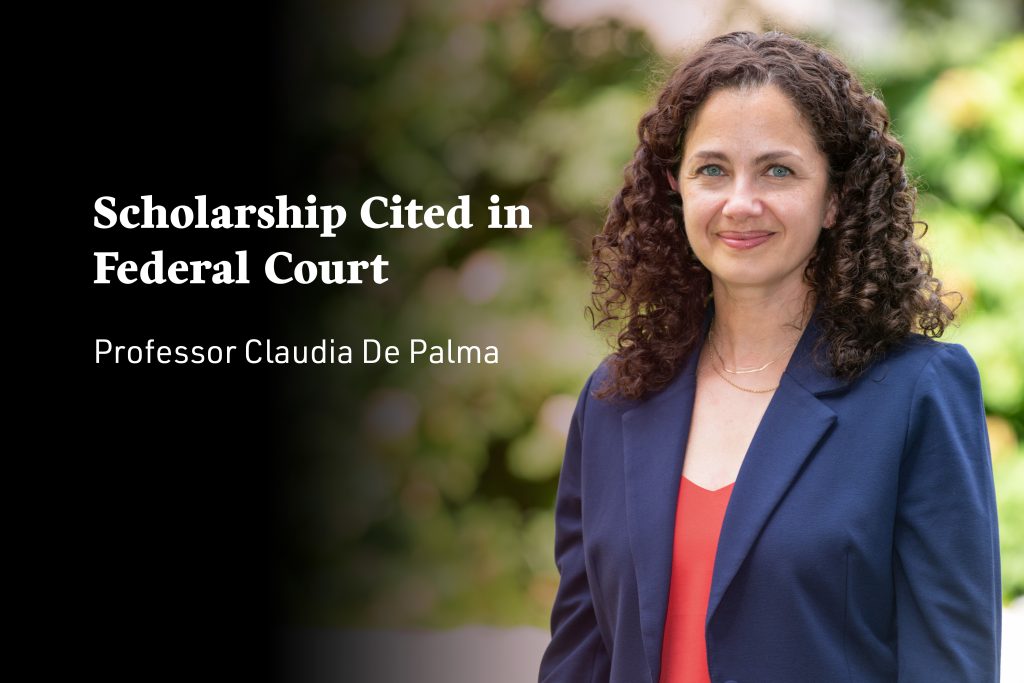
A forthcoming article by Professor Claudia De Palma and co-author Professor Karen Lindell at Penn Carey School of Law, was recently cited by Judge Michael H. Simon of the U.S. District Court for the District of Oregon in Dickinson et al. v. Trump et al., No. 3:25-cv-2170 (D. Or.) as influential in the Court’s consideration of motions by two parties to file amicus briefs in the case. De Palma and Lindell’s paper, “Friendly Gatekeepers: Lessons from an Empirical Analysis of Amicus Briefs in Federal District Courts,” challenges the conventional wisdom that amicus advocacy does not happen at the trial level.
Dickinson is a First Amendment case arising from alleged assaults by federal officers upon plaintiffs during protests outside the Immigration and Customs Enforcement Building in Portland, Oregon in 2025. The case was brought by the ACLU of Oregon on behalf of protesters and journalists in late 2025, and both the City of Portland and the State of Oregon soon moved to appear as amici curiae in support of plaintiffs. In considering the motions, the Court cited De Palma and Lindell’s findings that while some district courts reject amicus briefs as attempts to introduce new facts, others permit them for a variety of reasons.
In Friendly Gatekeepers, De Palma and Lindell conducted an empirical analysis of a 20-year longitudinal dataset of federal district court dockets with amicus filings and a dataset of 558 amicus briefs filed in cases initiated in 2019. Among other findings, they documented a rise in amicus filing rates in district courts in cases that have the potential for broad impact, even at the trial level. Using the dataset of cases filed in 2019, they further found that district court amici most often appear in administrative law cases and on motions for preliminary relief, and that they closely resemble their appellate cousins in both substance and role. The article will be published in Volume 45 of University of Texas Law School’s Review of Litigation.
“From its inception, I hoped our analysis could serve as a bench memo to aid trial-level judges grappling with the proper role of amicus briefs in their courtrooms,” De Palma said. “I’m thrilled to see the article doing just that: providing valuable context about the rarely discussed but increasingly significant phenomenon of amicus filings in federal district courts.”
De Palma, who joined the Temple Law faculty in 2025, is an Assistant Professor who specializes in legal writing, complex litigation, and public interest law. Her scholarship examines the possibilities, limitations, and consequences of using public interest litigation to remedy systemic inequality and discrimination. Prior to joining Temple Law, she was a senior attorney at the Public Interest Law Center in Philadelphia, where she engaged in impact litigation to advance the civil, social, and economic rights of communities facing discrimination, inequality, and poverty.