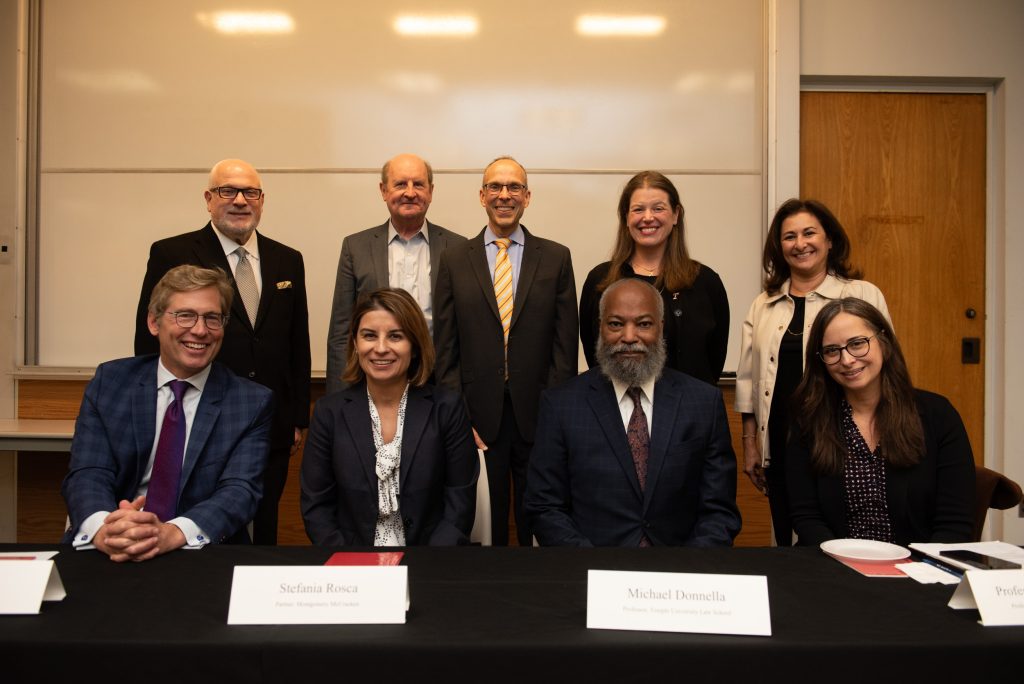
The Temple University Beasley School of Law was proud to host a Philadelphia Bar Association Chancellor’s Forum on October 28, 2025, with a panel of professionals who shared their experiences from different fields of international law. Co-sponsored by the Philadelphia Bar Association (PBA), Temple Law’s Offices of Career Services and Graduate & International Programs, and the International Law Society, the Chancellor’s Forum presented insights on building legal careers in international law. Students heard from Jeremy Heep, Partner and Head of International Arbitration at Troutman Pepper Locke; Alina Stefania Rosca, Partner in the Litigation Department at Montgomery McCracken; Professor Michael Donnella, Director of the Center for Compliance and Ethics; and Barrack Chair in Law Professor Rachel López.
Interim Dean Kristen Murray welcomed a diverse assembly of students, faculty, and practitioners. In what promises to be the first collaboration of many, the community gathered to discuss what it means to live and practice in a global economy. The PBA Chancellor, Katayun Jaffari gave the opening remarks and highlighted how Philadelphia is a great international city and the birthplace of American democracy. A city of firsts, Philadelphia is a global leader in numerous sectors of business and scientific discovery and home to America’s oldest bar association. Chancellor Jaffari encouraged students to join the PBA (membership is free through Temple Law’s institutional affiliation with the PBA) and apply for membership on the International Law Committee.
As the moderator, Assistant Dean John Smagula asked the panelists to share practical advice regarding skills and qualities valued by employers. From cross-border litigation over complex disputes, international arbitration, business law compliance for multinational companies, and the promotion of human rights to the development of international criminal law, the panel exemplified many pathways to private and public international law. The panelists encouraged students to leverage their language and communication skills and approach global issues as problem solvers. As the futures of both litigation and transactional lawyering become increasingly multi-jurisdictional, competence and specialization in international law add value to many firms.
The panelists emphasized that there is no single path to an international law career. Students and practitioners must create their own journeys and stories of success depending on their interests. To launch those journeys, students should consider study abroad opportunities offered by their law schools. The global reach of Temple Law, for example, allows for uniquely enriching international experiences as part of one’s legal education, such as spending a semester abroad in Rome, Italy or Tokyo, Japan.
The Chancellor’s Forum marks a strong partnership between Temple Law and the Philadelphia Bar Association. We are grateful for the Chancellor’s support and all the speakers’ inspirational remarks. Temple Law looks forward to collaborating more in the future and building on our tradition of international law advocacy.