New Access to Justice reports — and some new City funding

For the first time ever, the City is making funding available to help Philadelphians who have cases in debt-collection court but lack legal representation (which is the situation for most debt defendants). The new funding will support one or more trained “navigators” whose job will be to help people understand court procedures, their legal rights, and their options for resolving their cases.

The program is likely to track many of the recommendations in a report produced this spring by the Center’s Access to Justice Clinic. In that report, A Navigator Program for Philadelphia’s Debt-Collection Court, Paulina Calistru, Dominique Hazel-Criss, and Joe’lyce Waiters documented the need for a navigator program and made proposals for its design.

Our work was only one of the factors that led to the City’s decision to find money for a navigator program. Community Legal Services and the Philadelphia Bar Association played leadership roles; the courts signaled their support; and we have Councilmember Rue Landau and colleagues to thank as well. We’re grateful to have had the opportunity to work with these partners.

Another team of students produced a report on a different, and seriously threatened, program of assistance to unrepresented litigants — this one in Family Court. That program, the Family Court Help Center, is a walk-in space in the Family Court building. Staffed by Philadelphia Legal Assistance (PLA), the Center offers information and help with forms to people dealing with child custody and divorce.

Although the Center has a great track record, it may be headed for closure this fall because of federal funding cuts. In Potential Futures for the Philadelphia Family Court Help Center, Jamal Connelly, Solan O’Malley and Nina Torres detailed a range of options for keeping the Center open in the absence of federal funds. Unfortunately, the City has declined to step in, so the future of the Center is still uncertain. We are hoping that a solution will be found.

Update on Language Access in the Pennsylvania Courts

Today, the Sheller Center is releasing Justice on Paper: Gaps Between Language Access and Policy in Pennsylvania. This report focuses on how the Pennsylvania courts are addressing limited English proficient (LEP) individuals who use the state court system to defend and enforce important rights as tenants, domestic violence victims, and parents. Pranav Ramesh (‘26), Natalia Mahecha Baron (‘26), and Franchesca Johnson (‘26), who authored the report, found that the Pennsylvania courts have both made substantial progress and failed to live up to the statewide language access plan (LAP) issued by the Pennsylvania Supreme Court in 2017. Their investigation is based on surveys with attorneys and community advocates, student in-court observations, and interviews with court staff and advocates.

The report concludes with recommendations of how the Pennsylvania courts could even further improve language access for LEP individuals by comparatively looking at how other jurisdictions approached the implementation of their language access policies. The Sheller Center has a history of working on language access issues in the Pennsylvania courts, with its earlier reports, Barriers to Justice for Non-English Speakers in Pennsylvania Courts and Unfinished Business, published prior to the issuance of the statewide LAP.

Moshannon Valley Processing Center

Today, the Social Justice Lawyering Clinic (SJLC) publishes In the Shadow of the Valley: The Unnecessary Confinement and Dehumanizing Conditions of People in Immigration Detention at Moshannon Valley Processing Center. This report is the first to comprehensively investigate conditions at Moshannon, the largest facility in the Northeast that detains immigrants who are awaiting the processing of their deportation cases. It is written by Cristina Isabel de Arana (’24), Alex Leone (‘25), and Bianca Taipe (’25), law students in the SJLC.

The report is based on interviews conducted by a coalition of community-based organizations, law school clinics, and legal nonprofits who made site visits to the newly opened detention facility in Centre County, Pennsylvania in 2023. People who are detained at Moshannon are being held under punitive, inhumane, and dangerous conditions. They have tightly controlled schedules, live in a “pod” with 60-70 other people, wear brightly colored jumpsuits, and are restricted from accessing the outside world. Further, people at Moshannon have reported issues ranging from the inability to get medical care to physical and psychological abuse by staff. Despite Moshannon’s “conversion” into an immigration detention facility, it operates more like the former federal prison that it once was.

Immigration detention facilities like Moshannon, which cost millions of dollars per month to operate, have not created a fairer, safer, or more efficient immigration system. Instead, detaining immigrants is contrary to this country’s ideals of fairness, freedom, and opportunity. Rather than piecemeal reforms for an already broken system, the government needs to consider alternatives, such as community-based case management systems that can work with people to screen, process, and ensure their attendance at immigration court. For this reason, the report calls for the closure of Moshannon.

See news coverage of the report on WHYY, States’ Newsroom, and Telemundo.

Link to PDF

A Sheller Center First

In a first for the Sheller Center, clinic students have worked with the Philadelphia DA’s Office to assist with the prosecution of labor crimes. Carolina Fernandez (’25), Ingrid Lopez Martinez (’24), Lucas Masin-Moyer (’24), Drew Perkoski (’25), represented a group of workers who worked for a moving company called EJ Relocations LLC. They alleged that the employer failed to pay their wages and threatened them to prevent them from making legal claims for their wages. Assistant District Attorney Maria DiGeorge (‘21), a Temple Law alum and a former Sheller Center clinic student, leads the prosecution against the principals of the company, who were recently charged with intimidation of witnesses, conspiracy, and involuntary servitude.

Clinic students work with Kenyan NGO on threats from digital ID system

– by Valerie Wilson, L ’25

In the Access to Justice Clinic, our team of Kiko Galpin, Jackie Jaques, Lara Ormiston and Valerie Wilson worked this spring with Haki na Sheria, a Kenyan NGO “dedicated to ending the discrimination and promoting the rights of marginalized communities in Northern Kenya.”  Our task was to produce a report about the impact of Kenya’s “Maisha Namba” digital ID program on Kenyan Somalis and other groups that struggle with access to identity documents because of discrimination and marginalization in Kenyan society. (The clinic was co-taught this semester by Laura Bingham of the Institute for Law, Innovation and Technology (iLIT) and Len Rieser of the Sheller Center.)

Haki na Sheria has done extensive community education and legal empowerment work with the Kenyan Somali community in Garissa County, a rural area in Kenya’s northeast. Haki na Sheria advocates to promote the right to a nationality and to prevent statelessness, and provides accompaniment for members of the Kenyan Somali community who are applying for national identity cards, which provide proof of nationality and are issued to Kenyans from age 18.

 In Kenya, these national identity cards are required to work, pay school fees, and attend university. But obtaining an identity card is difficult for the people Haki na Sheria works with because of a complex practice called “vetting,” in which members of specific communities must undergo extensive security checks and heightened scrutiny to confirm their citizenship (which should be established from birth) and acquire the all-important national ID card.

After years of efforts by Haki na Sheria and other civil society groups to eliminate vetting, the practice still exists, and the Kenyan government’s decision to adopt a digital ID system has created even more uncertainty for this community and poses serious risks to their future financial, social and political inclusion. In 2020 and 2021, Haki na Sheria, along with other civil society organizations, successfully challenged a previous effort to implement digital ID (“Huduma Namba”) in the Kenyan courts, on the grounds that the project lacked an adequate legal framework to address privacy and discrimination risks. However, when the current government came into power in 2023, it announced another digital ID program under a different name — Maisha Namba — without engaging in the necessary legal and policy reforms to protect the rights of the Kenyan Somalis, other vulnerable communities, and the public in general.

When we started this project, a legal challenge to the Maisha Namba system had temporarily stalled the project through an injunction, and we therefore approached problems with the system from a theoretical standpoint. But in February 2024, the Kenyan High Court lifted the injunction on Maisha Namba’s implementation and the system began to move forward with the issuance of new cards. Our focus shifted to include current logistical and administrative problems with the actual implementation of the system on the ground. We decided to structure our report around the UNDP Digital ID Model Governance Framework, which assesses digital ID systems based on multiple dimensions of human rights.

We conducted a literature review and interviewed community members, paralegals, and government officials who have dealt with the current ID systems and application processes in Garissa County. In the end, we were able to produce a comprehensive account of the human rights risks of digital ID tailored to the specific experiences and circumstances of the Kenyan Somali community and similarly situated groups that are forced to undergo discriminatory vetting to access identity documents proving they are Kenyan.

Our report will be the first that we know of to apply the UNDP Model Governance Framework in practice, and to provide an in-depth discussion of the impact that the Maisha Namba system will have on the Kenyan Somali community. We are eager to see how this project develops in the Advanced Access to Justice Clinic in the Fall 2024 semester. We also hope that our report spurs more researchers to study the effects of digital identity systems and other forms of digital public infrastructure on marginalized groups.
Some progress in debt-collection court

Judgments routinely favoring debt-buying companies, typically against low-income folks who may not have received proper service, understood their rights, or managed to present their defenses: that has been, at least in considerable part, the story of debt-collection court in Philadelphia. Sheller Center students have been working on the problem for several years, in partnership with Community Legal Services, the National Center for State Courts, other advocates, and the courts themselves. We’ve produced a series of reports (links below), and have done some direct representation in order to see, up close, how the process works.

Last month, we had a trial in Common Pleas Court in a credit-card-debt case that we had lost twice — first in Municipal Court, then in arbitration proceedings. Students Cathy Ginder and Nicole Kerr had worked on this case, in which — as often occurs — the debt-buyer relied on hearsay documents and offered no proof of most of the charges that our client had supposedly incurred. Those deficiencies were ignored at the earlier hearings, but on our third try, the Court saw a problem — and entered a judgment that largely favored our client.

Progress has come slowly, but we think we may finally be getting somewhere – most recently as an invited member of a new committee, convened by Municipal Court and including representatives of plaintiffs as well as defendants, charged with recommending changes. We’re looking forward to advocating for a fairer system.

Our reports:

Six Practical Ways Courts Can Reduce Default Judgments in Debt Collection Cases

Toward a More Level Playing Field: A Navigator Program for Philadelphia’s Debt-Collection Court

Preventing Unfair Default Judgments in Debt Collection Cases: Proposals for a Compliance Checklist

Enhancing Due Process in Consumer Debt Proceedings

Students Participate in Workers Summit  

Social Justice Lawyering Clinic students, students, Adam Karbeling (’24), Jackie McCann (‘25), and Alex Suarez (’25), have partnered with the Pennsylvania chapter of the National Domestic Workers Alliance (NDWA-PA) to draft stronger legislation to protect domestic workers against retaliation, exploitation, and other unfair and illegal practices. Together along with other worker advocate groups, the NDWA-PA organized the Philly Workers Fight Back Summit in November, which brought different workers together to share stories, find solidarity, and devise strategies concerning the draft legislation. “It was great to see the excitement surrounding this legislation at the Philly Workers Fight Back Summit, where everyone I talked to was interested in various details of the legislation and had thought deeply about it,” said Karbeling, who attended the event. See here for Philadelphia Inquirer coverage of the event.

Helping Temple students understand their rights as tenants

In this week’s Temple News, journalism student Alayna Hutchinson reports on a plan by students in our Social Justice Lawyering Clinic to provide better information to Temple students — especially undergraduates — about their rights as tenants in off-campus housing. Casey Dwyer and Anna Manu Fineanganofo, 2Ls, developed the plan in consultation with the Office of the Dean of Students, the Cherry Pantry, and the Law School’s student-organized Housing Justice Initiative. Law students participating in the program would offer legal information to students with questions about their leases or rental conditions; if legal advice or representation were needed, a student could be referred to one of Philly’s legal services organizations.

We’re grateful to Temple News reporter Alayna Hutchinson for digging into the important issue — well documented by Temple’s own Hope Center — of how to get more legal help to students with problems involving basic needs.

Taking our work on the road

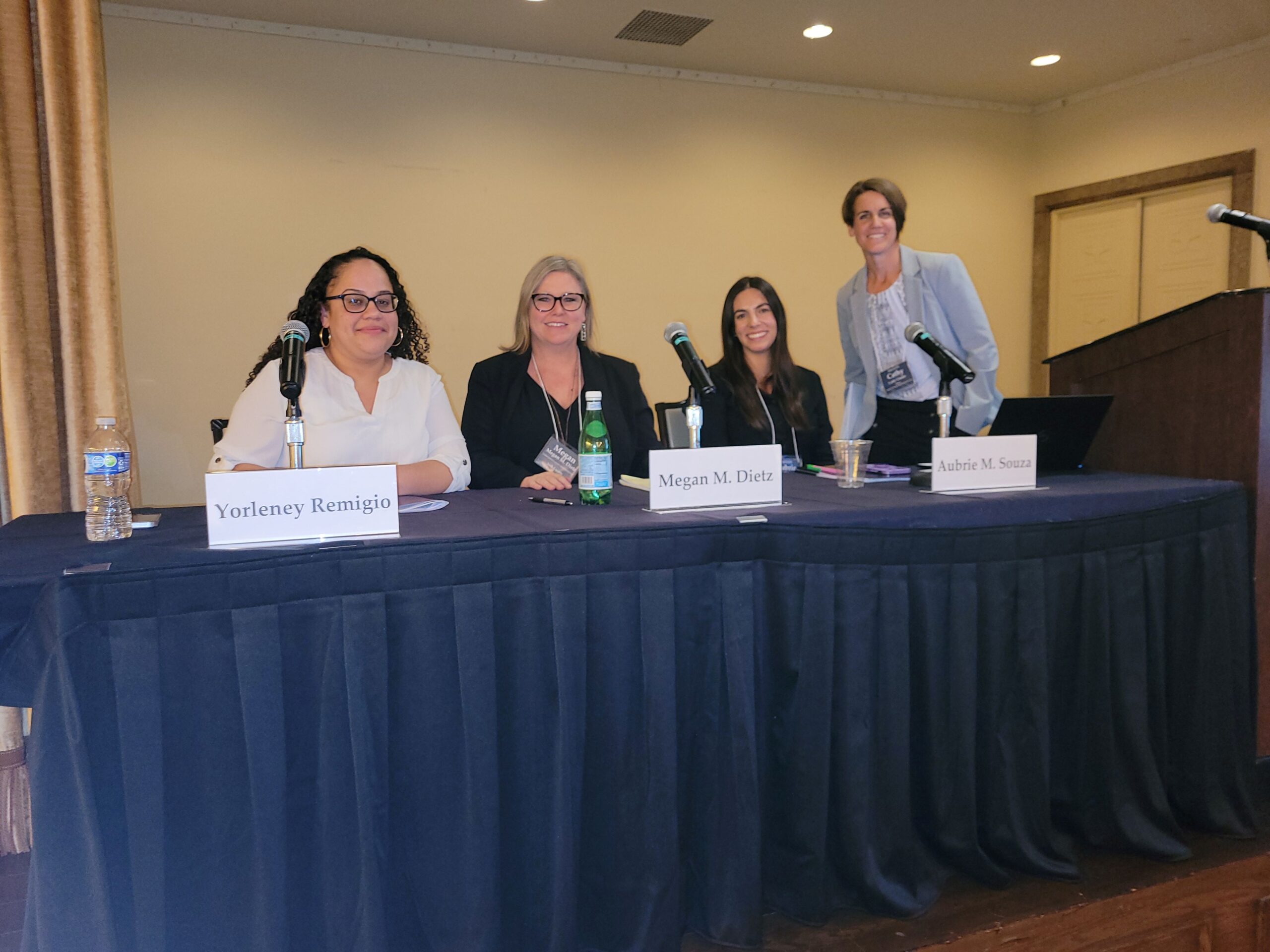
four people sitting and standing at a conference table

“An unrepresented person walks into a courthouse” might sound like the beginning of a joke, but in real life it’s a recipe for intimidation, confusion and stress. That’s where court-based help centers can make a difference, according to a report produced by students in our Access to Justice Clinic (“Justice for All: The Current Success of Self-Help Centers in Pennsylvania Courts and Recommendations for Growth)”. So we were excited to be invited, this month, to present our findings to the Pennsylvania Association of Court Management, PA’s organization of court professionals, at their Pittsburgh meeting.

As the report explains, self-help centers offer a comfortable environment where litigants can get assistance in understanding court procedures, filling out forms, and navigating other mystifying aspects of the judicial process. The centers benefit not only the public, but also judges and court staff, whose work becomes easier when people are able to follow the rules for being heard. And PA has some successful centers — though there are also still many counties that do not have them. (By contrast, some states have help centers in most or all of their courthouses.)

Cathy Ginder, L ’25, one of the authors of our report (at the right in the photo), planned the Pittsburgh session, invited the presenters, and moderated the discussion. Megan Dietz and Yorleny Remigio, stars of the York County Court Self-Help and Law Resource Center, explained how their center was created and why litigants and judges so strongly support it. Aubrie Souza, Court Management Consultant for the National Center for State Courts, generously traveled from Boston to add a national perspective and to offer her organization’s assistance to PA courts. (NCSC recently released its own report on self-help centers around the country.)

We hope our presentation will lead more PA counties to consider creating help centers. And we’re pleased that our clinic now has a connection to PACM, which is on the front lines of making justice more accessible to Pennsylvanians.

Protecting Immigrants in Need of Long-Term Medical Care

In late September, Philadelphia City Councilmember Jim Harrity introduced a bill seeking to end medical deportation in the city by hospitals. Three Temple Law students in the Social Justice Lawyering Clinic, Sarah Hampton (’22), Livia Luan (’23), and Adalberto Rosado (’23), worked along with the Free Migration Project to draft this ordinance ensuring that ill, injured, or elderly uninsured patients will not be deported to their country of origin against their will due to financial or language barriers. Check out this Philly Inquirer article that has more about this practice and how this bill will assist this endangered population.

Latest update: On December 14, 2023, the bill passed 14-1 in the final session of City Council for the year.