Center launches Access to Justice Clinic

What’s an important aspect of our legal system that law students typically don’t learn about? Here’s one: the fact that vast numbers of Americans deal with their civil legal problems without help from lawyers. In landlord-tenant matters, in family court, in consumer and benefits cases, and in many other critical situations, Americans now mostly go it alone.

This reality contrasts sharply with the world of the law school casebook, in which no one, it seems, goes through a legal process without a knowledgeable attorney at their side. For many reasons — including high fees, the shortage of legal aid and pro bono help, the increasing complexity of laws and procedures, and more – that’s just not how our system actually works these days.

Enter the civil “access to justice” movement, which seeks to ensure that America’s justice systems work for everyone – not just those with high incomes. And enter the Sheller Center’s Access to Justice Clinic, launched this fall. In this clinic, six students are engaging in hands-on projects addressing access-to-justice problems in Philly. One project concerns the difficulty that unrepresented Philadelphians have in getting even a simple divorce. Another involves the high number of default judgments in landlord-tenant court, which result in evictions without the court ever hearing the (typically unrepresented) tenant’s side of the story.

It’s too early to say where the students’ work will lead, but the Clinic is off to a good start. The new clinic is just our most recent attempt, by the way, to engage students in improving access to justice in Pennsylvania (see our work on fair treatment for non-native speakers of English in court proceedings for another example). We hope you’ll check back as the year progresses to learn more about our Access to Justice Clinic and other projects.

Upcoming event: “Banned: Immigration Enforcement in the Time of Trump”

The Center invites you to hear Penn State Prof. Shoba Sivaprasad Wadhia discuss her new book, “Banned: Immigration Enforcement in the Time of Trump,” September 12th at noon at the Law School, Klein Hall Room 2B. Prof. Jill Family of Widener Law School will offer comments.

This presentation is co-sponsored by the Law School’s Institute for International Law and Public Policy, National Lawyers Guild, the South Asian Law Students Association and the Sheller Center for Social Justice.

Ending the detention of migrant children in Pennsylvania

Detention is no place for migrant children. In Berks County, Pennsylvania houses one of three family detention facilities in the country. While Governor Wolf states that he finds such detention “inhumane,” he claims he cannot do anything about it. Professor Jennifer Lee’s Op-Ed in today’s Philadelphia Inquirer details why this claim is untrue. Since 2015, students in the Social Justice Lawyering Clinic have been working with the Shut Down Berks Coalition to bring attention to the facility and argue for its closure.

Pennsylvania local governments are heavily involved with federal immigration enforcement

A report released today, Interlocking Systems: How Pennsylvania Counties and Local Police Are Assisting ICE to Deport Immigrants, reveals the extent of collaboration between local governments and ICE in the era of the Trump administration. Many local governments in Pennsylvania have made the choice to actively engage and support federal immigration enforcement. In contrast, other local governments across the country have opted not to use their local resources to assist ICE.

The report was prepared for Juntos by Amy Chin-Arroyo (‘20), Solena Laigle (‘20), and Prof. Jennifer Lee with the Social Justice Lawyering Clinic.

Pennsylvania counties, for example, are consistently collaborating with ICE pursuant to written policies or informal practices. County jails and probation departments regularly share information about immigrants and help ICE to locate and arrest immigrants. Local police collaboration with ICE appears to be less systematic and mostly ad hoc, with individual officers choosing to become involved in federal immigration enforcement.

Further, the report provides information about the eight federal contracts in Pennsylvania to detain immigrants in county jails for civil immigration violations. It details the significant human costs of jailing such immigrants while counties are profiting off the growing numbers of immigrants in civil detention.

Most recently, some cities and towns have canceled their lucrative federal contracts to detain immigrants in county jails or prisons. Local governments are reconsidering how to best use their resources to serve their local communities rather than the federal ICE enforcement machinery.

Some of the key findings from the report are outlined below:

  • County jails systematically share information with ICE on a weekly, if not daily basis.
  • County probation officers work with ICE to entice immigrants to come in for appointments so they may be arrested by ICE.
  • Pennsylvania counties receive millions of dollars for jailing ICE detainees, who are being held for civil immigration violations.
  • In 2017 and 2018, the ICE detainee population in Pennsylvania increased.
  • Inspection reports of these county jails have revealed that ICE detainees lack access to medical care.
  • ICE has actively courted police departments in Pennsylvania to engage in federal immigration enforcement.
  • The lack of formal written policies in police departments about interactions with ICE has created an opening for individual police officers to act based on their own personal inclinations.

All documents obtained from counties and police departments through the Right to Know Law are available here.


Popular anti-wage theft strategies may not be effective

A newly released study conducted by Prof. Jennifer Lee and co-author Prof. Annie Smith compiled 141 state and local anti-wage theft laws enacted over roughly the past decade. In reviewing these laws, they found that the most popular anti-wage theft strategies involve authorizing worker complaints, creating or enhancing penalties, or mandating employers to disclose information to workers about their wage-related rights. Lessons learned about these regulatory strategies in other contexts, however, raise serious questions about whether these state and local laws can be successful. At the same time, they identified more promising regulatory innovations, such as new collaborative approaches to enhance agency enforcement.

Given the hostility to low-wage worker rights at the federal level, this study hopefully informs advocacy groups and policymakers that are attempting to address the pernicious practice of wage theft at the state and local level. A review of the study by Prof. Sachin Pandya can be found in Jotwell. Additional data from the study can also be accessed here.

Restrict inquiry into immigration status in unrelated cases, law professors urge

If you’re in court for a landlord-tenant case, or an auto accident or domestic violence hearing, should the other side be allowed to ask about your immigration status? Common sense suggests that the answer is no. Unless the case is actually about your immigration status, it’s just not relevant – and it could be prejudicial.

In fact, the prospect of being asked about immigration in an unrelated matter can easily frighten immigrants from seeking justice in court, even when they have valid claims or defenses – as both the Sheller Center and PA’s Interbranch Commission have reported.

Pennsylvania’s rules of evidence, however, haven’t addressed the problem until recently, when the PA Supreme Court Rules Committee proposed a new “comment” to the rules. The comment would say that a person’s immigration status is generally irrelevant and inadmissible.

In response, law professors from Drexel, Penn, Penn State, Pitt, Temple (including the Sheller Center), Villanova, and Widener submitted a letter strongly supporting the proposal – while also arguing that it does not go far enough.  Instead of addressing the issue through a non-binding comment, the letter states, the Committee should develop an actual rule – such as exists in California and Washington – that would provide clear, non-discretionary guidance to judges, lawyers, and parties.

Asking city council to fund enforcement to protect workers

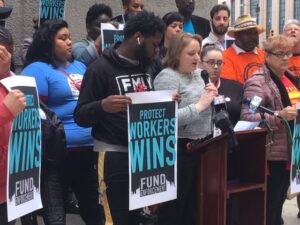
Philadelphia has legal protections for low-wage workers on the books, including paid sick leave and an ordinance to address wage theft. The problem, however, is that these legal protections for low wage workers do not amount to much if they are not actually enforced. Representing the Sheller Center, Lily Austin (’20) spoke at a press conference at city hall about the need for sufficient funding, particularly to educate workers and employers about these laws. She explained how the city cannot sit back and wait for complaints to come. Rather, the city needs to work in active partnership with community groups, who already have the trust of these workers, by providing sub-grants to community-based organizations to educate low-wage workers. It must also work cooperatively with communities to proactively target employers or industries who are likely to be violating the laws.


Philadelphia Sheriff moves to halt ICE arrests at city courthouses

According to the Philadelphia Inquirer, the Philadelphia Sheriff has reached an agreement with ICE to stop arrests of immigrants in courthouses in Philadelphia. The Sheriff has the responsibility to provide safety and security for courthouses. This agreement also requires that ICE agents identify themselves upon entering the courthouse, declare whether they are armed, and state where in the building they intend to go. The Sheriff’s Deputies will alert their supervisors, who will contact the presiding judge.

The new policy is consistent with some of the recommendations in the Sheller Center’s Report, Obstructing Justice. In the report, law students amassed information about the devastating impact that ICE arrests are having on immigrant communities, making victims, witnesses, and defendants fearful to access the courts. Since the report was released, there have been several local and national stories about the continued impact of ICE arrests on such communities.


Philadelphia Sheriff moves to halt ICE arrests at city courthouses

According to the Philadelphia Inquirer, the Philadelphia Sheriff has reached an agreement with ICE to stop arrests of immigrants in courthouses in Philadelphia. The Sheriff has the responsibility to provide safety and security for courthouses. This agreement also requires that ICE agents identify themselves upon entering the courthouse, declare whether they are armed, and state where in the building they intend to go. The Sheriff’s Deputies will alert their supervisors, who will contact the presiding judge.

The new policy is consistent with some of the recommendations in the Sheller Center’s Report, Obstructing Justice. In the report, law students amassed information about the devastating impact that ICE arrests are having on immigrant communities, making victims, witnesses, and defendants fearful to access the courts. Since the report was released, there have been several local and national stories about the continued impact of ICE arrests on such communities.


Creating a worker center in Philadelphia


Together with the Pennsylvania Immigration and Citizenship Coalition (PICC), Heather Adamick (‘21), Joshua Lachewitz (‘21), and Pretty Martinez (‘21) from the Social Justice Lawyering Clinic organized a convening about creating a worker center in Philadelphia. A worker center would help organize, advocate, and provide services to low-wage workers in Philadelphia. Individuals representing sixteen organizations attended from across Philadelphia. The purpose of the convening was to present information about the many conversations that the students have had with various stakeholders and to hear from advocates about what sort of worker center would best serve the needs of Philadelphia’s low-wage workers.