August 5, 2026
Ten years ago, I got a call that changed my life. Congress had just enacted the Puerto Rico Oversight, Management, and Economic Stability Act—PROMESA, or “promise” in Spanish—Congress’s response to Puerto Rico’s dire economic crisis. PROMESA created a seven-person oversight board with the power to restructure Puerto Rico’s $74 billion of debt and to balance the island’s budgets. The call came from Senate Majority Leader Mitch McConnell’s office, inviting me to interview for one of McConnell’s four nominations to the oversight board, from which President Barack Obama would pick two.
When I interviewed for a different job thirty-seven years ago—an appointment to the faculty of what was then known as Temple University School of Law—one of the first questions I was asked was whether I intended to engage in public service after I started my teaching career. I said yes, but the question took me by surprise. It wasn’t something I had really thought about. After joining the faculty, I quickly discovered that it hadn’t been a random question. The Conwellian tradition of making higher education available to families who had never previously sent a child to college lay at the heart of the law school’s mission, and a public-spiritedness pervaded everything we did. I believe this spirit helped to shape me as a law professor, making me much more alert than I otherwise would have been to opportunities for public service.
I’d had minor opportunities for public service over the years, but nothing remotely like this. If I were selected, I would be committing to thousands of hours of unpaid work on top of my regular job, and the board—a group of unelected officials sent from Washington—would be highly controversial in Puerto Rico. But this also might be a chance to use my bankruptcy expertise to help improve the lives of three million American citizens. I jumped at the opportunity. President Obama did appoint me, and I served on the oversight board for nearly eight years, the last three-and-a-half as chair. During this time, the Commonwealth of Puerto Rico completed the largest governmental debt restructuring in American history, and we restructured the debt of eleven other governmental entities as well.
The Commonwealth bankruptcy—which restructured $35 billion of the island’s $74 billion of debt and shored up its radically underfunded pension system—took five years. It was a wild, wild ride, punctuated both by natural disasters such as Hurricane Maria in 2017, earthquakes in 2020, and the COVID-19 pandemic in 2020; and by human obstacles such as creditors’ attempts to have the board members’ appointments declared unconstitutional and by the exploits of a rogue board member.
In addition to $7.1 billion of cash and $7.4 billion of new bonds, Commonwealth bondholders (who were owed $18.7 billion) received an innovative “contingent value instrument,” or CVI, in the Commonwealth restructuring. If Puerto Rico’s sales tax revenues exceed expectations in a given year, the bondholders receive an additional payment; if not, they don’t. Although this CVI bears a family resemblance to GDP-linked warrants that have been used in a few sovereign debt restructurings (including Argentina in 2005 and Ukraine in 2015), it has two enormous advantages: (1) sales tax revenues only go up if the economy has improved and the debtor can afford to make an extra payment, whereas a rise in GDP does not always reflect an increased ability to pay (as with Ukraine in 2015); and (2) sales tax revenues are much more difficult to manipulate than GDP. The CVI helped to bridge the gap between the bondholders’ belief that the Commonwealth could afford to pay more, and the board’s concern that it could not. It is an important new addition to the municipal restructuring toolkit.
The Puerto Rico debt crisis isn’t just about Puerto Rico; it’s also about the United States. The Puerto Rico crisis is a case study of how governments at the city, state, or federal level become dysfunctional, what the options are when they do, and how well an option like state bankruptcy might work.
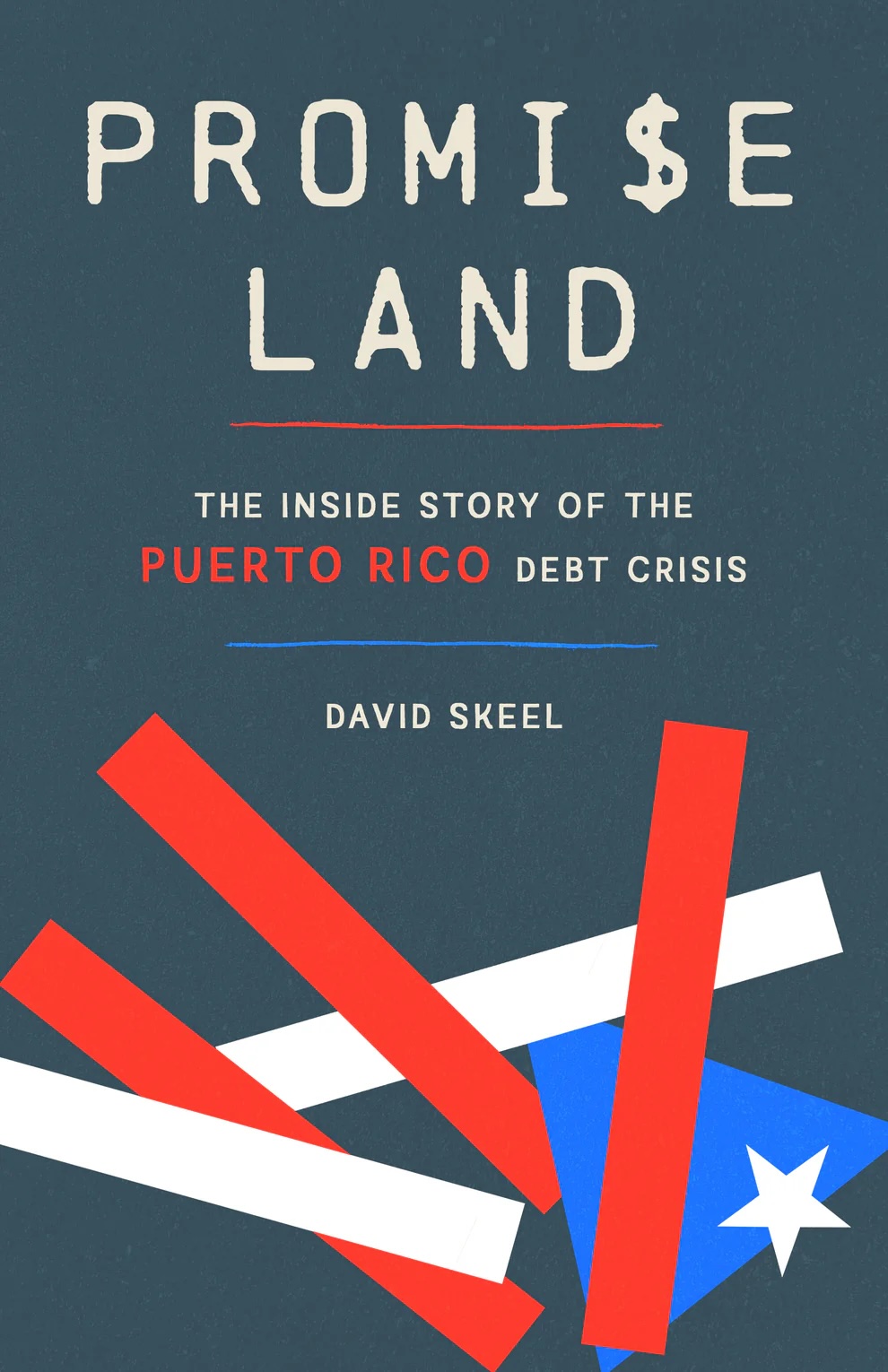
I tell the story from my perspective as a key participant in a new book called Promise Land: The Inside Story of the Puerto Rico Debt Crisis. The book is intended to be fun to read, like Caesars Palace Coup, or The Smartest Guys in the Room, Bethany McLean’s book about the Enron scandal.
David Skeel is the S. Samuel Arsht Professor of Corporate Law at the University of Pennsylvania-Carey Law School. Before joining Penn’s faculty, Professor Skeel taught bankruptcy, corporations and related business law subjects at Temple Law School.