Social justice spotlight: John Farrell

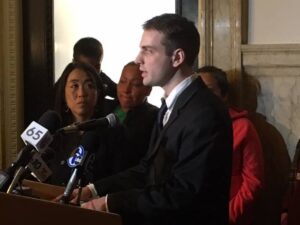
Our second “Social justice spotlight” of the semester is by John Farrell, 3L. The photo shows John at the press conference at which the Urgent Appeal to the UN Working Group on Arbitrary Detention was announced.

We, Mariya Tsalkovich, Anthoy Sierzega, and John Farrell, worked to challenge the U.S. government’s detention of families at Berks Family Detention Center in Pennsylvania, through the Sheller Center Social Justice Lawyering Clinic. Closely in conjunction with Juntos, a community-based immigrant advocacy organization, we helped to advocate for closure of Berks by arguing that these practices violate state, federal, and international law. Berks has been keeping children and families who seek asylum within the United States in prison-like conditions for potentially indefinite periods, violating their due process rights.

Over the course of our semester, we filed an Urgent Appeal with the United Nations Working Group on Arbitrary Detention, co-wrote an Amicus Brief on behalf of psychological providers in the state litigation related to the licensing of the facility, and created educational materials to bring these practices to light. It was an honor to be a part of these efforts, working closely with seasoned practitioners and community members alike. We got to have a direct hand in advocating on behalf of some of the most vulnerable immigrants coming to the United States.

Social justice spotlight: Wesley Stevenson

For our “Social justice spotlight” series, we ask students who participate in Sheller Center clinics and programs to talk a bit about their experience.  This week, we hear from Wes Stevenson, a third-year law student.

Over the past year, I’ve been working with the Sheller Center’s Justice Lab Clinic to end the City of Philadelphia’s practice of charging parents for their children’s incarceration costs.  During that time, every person I’ve talked to about the issue has expressed the same outrage and confusion I felt when I first learned this was happening.  Yes, this really happens, and it happens all across the nation.

This work is critical because the practice is fundamentally unjust, it hurts families during a critical time, and it has no real financial benefit for the City. And it has been going on for a long time.  Our work has been about ending the practice so no more families face these support orders.  But it has also been about holding the City accountable, for imposing these costs on working families for years, and ensuring that when the practice does end, it ends for good.

Philadelphia City Council has scheduled a hearing on the practice for March 3, 2017, at 11:00 a.m., in the Council chamber at City Hall.  I am grateful for the opportunity to testify at that hearing, alongside affected parents and advocates, and I’m hopeful that by the time I graduate, these collections will have officially stopped.

What’s in a Name? The “Sanctuary” Label

The Washington Post just announced that Bedford County, PA has reversed its policy of refusing to honor detainers by U.S. Immigration and Customs Enforcement (ICE). The county did so in response to being labeled as a “sanctuary city” by immigration-restrictionist groups like Federation for American Immigration Reform (FAIR).

Using the Sheller Center’s Report on ICE detainers in Pennsylvania, written by students in the Social Justice Lawyering Clinic, groups like FAIR have been slapping labels on jurisdictions within Pennsylvania. These groups, however, overlook the essential details of the Report, which never once uses the word “sanctuary.” Rather, the Report discusses local policies on ICE detainers in the aftermath of the Third Circuit decision in Galarza v. Szalczyk.

Some background: detainers are requests by ICE to local authorities to hold individuals, who would otherwise be released, for pick-up by ICE. In Galarza, the Third Circuit held not only  that ICE detainers constitutionally could only amount to requests (as opposed to mandatory orders), but also that local jurisdictions could be held liable for choosing to wrongfully imprison someone solely on the basis of an ICE detainer. Our Report subsequently found that nearly half of Pennsylvania’s counties had decided, for these and other reasons, not to honor ICE detainers. Officials who volunteered their motivations mostly referred to the Galarza decision, while several mentioned the practicalities of limited bed space or the lack of reimbursement from the federal government.

But now Bedford County is backtracking because of the “sanctuary” label. Would Bedford County have left its policy in place if it had been called something else? Maybe. In our discussions with one Bedford County official, we were left with the impression that the policy change had been carefully considered after realizing that ICE holds were not mandatory and that the county faced potential legal liability.” Had the “sanctuary” label not been applied, county officials might have drawn on these discussions to explain to their residents the value of the policy in protecting the county from liability. Or one could imagine county officials convincing residents of the need to conserve law enforcement resources to address local problems rather than federal concerns.

So is the lesson for immigrant advocates to back away from the word “sanctuary”? As the Bedford County story confirms, the term has become pejorative in some circles (legislators in Harrisburg currently have four bills targeted against sanctuary cities and campuses). Some also believe that the term sanctuary is problematic because it inaccurately describes a refuge or place of safety – while the truth is that, regardless of a city’s policy regarding cooperation with ICE, ICE can enforce federal laws in any jurisdiction.  But other people embrace the term “sanctuary,” because it connects to historical efforts to protect people from unjust arrest – such as the underground railroad in the nineteenth century, or the refuge provided to Central Americans refugees during the civil wars of the 1980’s.

The strategic use of language is crucial to the success of social justice movements. But how do you decide on whether a term like sanctuary should be used in the advocacy context? In answering this question, I like the conclusion that our class arrived at the other day. As social justice lawyers, we should leave the choice of language to the people who are directly impacted by the issues.

Report addresses strategies for preserving affordable housing

Philadelphia has a severe shortage of affordable housing.  “Danger of the Opt Out,” a new report developed by Fall 2016 Justice Lab students for Community Legal Services, shows that the City is at risk of losing even more affordable units as landlords opt out of participation in the Section 8 program.

The report notes that the loss of housing has a distinct racial impact, since 63% of African-Americans live in project-based housing compared with 44% of the city’s population, and that African-Americans are disproportionately likely to carry severe housing cost burdens. According to the report:

  • Over 9,000 units of affordable housing may be lost in the next 20 years across 86 Section 8 project based properties.
  • Eighteen of those properties are in gentrifying census tracts, which are at greater risk of opt-out due to changing neighborhood demographics. Of the 21 properties with Section 8 contracts expiring by 2020, six are located in a gentrifying tract.
  • A majority of affordable units are at higher risk of opt-out due to the owner’s for-profit status, since a profit-motivated owner is more likely to opt-out when they are able to obtain higher rents on the private market.

​Following release of the report, Community Legal Services attorney Rasheedah Phillips echoed its call for changes in the way PHA does business. Recommendations include stronger requirements for advance notice to tenants when their home is to be removed from the Section 8 program, and the development of an open database of all Section 8 properties and the dates on which their contracts with the program are set to expire.

Philadelphia Weekly covered the report, noting that it “offered a stark reminder of the extent of Philadelphia’s housing crisis.” The report has also been cited in a Harvard Law School blog, as well as by Voices for Civil Justice and other national organizations.

Continued questions about Philly’s “Rental Assistance Demonstration Program”

Last summer, students in the Center’s Justice Lab Clinic released their Philadelphia Rental Assistance Demonstration Program Advocacy Guide.  The “RAD” program, an initiative of the federal Department of Housing and Urban Development, allows municipalities to invite investors to support “conversions” of housing units from public to private ownership. But according to Justice Lab, which studied the program in collaboration with Community Legal Services, inadequate steps have been taken to protect low-income tenants as conversions go forward.

As a follow-up, Fall 2016 Advanced Clinic student Martha Guarnieri analyzed new RAD conversion data and discovered that the Philadelphia Housing Authority is not disclosing how much housing RAD is creating or which private developers have contracts in Philadelphia.  This information was used in testimony offered by CLS to the Philadelphia Housing Authority and the Philadelphia Division of Housing and Community Development concerning the City’s draft “Assessment of Fair Housing.”  Justice Lab and CLS urged PHA to revise its Assessment to include more transparency and data about the RAD program and its potential impact on the City’s already-insufficient low-income housing supply.

Center files brief on traumatizing effects of long-term detention on children

The Center’s Social Justice Lawyering Clinic, together with the Villanova Farmworker Clinic, has filed an amicus brief in support of the Pennsylvania Department of Health and Human Services’ decision to revoke the license of the Berks County Family Detention Center.  That decision has been appealed by Berks County, which the federal government pays to confine immigrant families at the Center. For more information about the Center, see our publications page.

Our brief was filed on behalf of Psychologists for Social Responsibility, plus a number of physicians, psychologists, social workers, and nurses. Many of these individuals have visited the facility and and found that it poses a severe and unjustified risk to children’s health, mental health, safety and well-being. The brief documents abuses at the Center and argues that its operation violates Pennsylvania law. In a similar case, a Texas court recently found that family detention facilities there violated the state’s human services law.

Human Rights First and the Shut Down Berks Coalition also provided crucial assistance for the Center’s brief.

Center to co-sponsor teach-in on immigrants’ rights

The Sheller Center is co-sponsoring a state-wide teach-in on immigrants’ rights in the wake of the election, to be held on Thursday, January 12 from 4:30 to 7:30 pm. The event will take place at Penn State and at the University of Pennsylvania Law School (Room T-145), with speakers and audiences in both locations and live-streaming between sites.  Topics will include Immigration Law 101; “Muslim” Registry; Policy Setting at the State and Local Level; “Sanctuary” from a Faith Perspective; and Immigration Enforcement. Participating law schools include Penn State, Penn, Temple, Drexel and Villanova. More information is available here.

PhilaPOSH recognizes work of Jen Lee and Sheller Center students

At its Annual Awards Reception last week, the Philadelphia Project on Occupational Safety and Health (PhilaPOSH) presented Prof. Jennifer Lee with its Crystal Eastman award for the Sheller Center’s work on behalf of “the most marginalized and vulnerable workers in Pennsylvania.” PhilaPOSH  specifically noted the Center’s report, “Shortchanged,” which exposed wage theft in Pennsylvania and led to the enactment of a city ordinance creating remedies for wage theft. Students in the Social Justice Lawyering Clinic, Amanda Reed (’15), Andrea Saylor (’15), Maggie Spitzer (’15), Elyssa Geschwind (’14), and Solaris Power (’15), researched and wrote the report.jen-lee-philaposh-award

The award is named after Crystal Eastman, an activist lawyer who co-founded the American Civil Liberties Union and the Women’s International League for Peace and Freedom – and whose many accomplishments included writing a report that led to the first workmen’s compensation law.

“First lockup, then debt”: Philly practice of charging parents for their children’s incarceration hits the news

Earlier this year, Justice Lab students Wesley Stevenson, Kelsey Grimes, and Sela Cowger, in collaboration with the Youth Sentencing and Reentry Project, began to investigate Philadelphia’s practice of billing families for the cost of incarcerating their children. The students’ efforts caught the attention of the Inquirer, which ran an in-depth article on the practice today, with quotes from student Wes Stevenson and Clinical Professor Colleen Shanahan.

Besides noting the hardship imposed on Philadelphia households, the article points out that the city’s practice reflects a national pattern in which juvenile justice systems are increasingly passing on their costs to families already living in poverty.

After receiving the Justice Lab analysis and working with the students since last spring, City officials told the Inquirer that they want to end the practice of billing parents, and are in discussions with the state Department of Human Services.  (Meanwhile, the private attorney who does the collections under a contract with the City told the paper that being billed for their children’s incarceration can actually help families, “because once the child‐support payments end, it’s like getting ‘a raise.’” )

For the full article, click here.

Guest Post: Learning to be a Social Justice Lawyer in Trump’s America

Our first guest post comes from Tony Sierzega, a second-year student in the Sheller Center’s Social Justice Lawyering Clinic. Of course, guest posts reflect the personal views of the authors; we welcome a diversity of viewpoints.


Learning to be a Social Justice Lawyer in Trump’s America

Tony Sierzega

            “No martyr is among ye now

            Whom you can call your own

            So go on your way accordingly

            But know you’re not alone” – Bob Dylan, “I Dreamed I Saw St. Augustine”

During my first class after Donald Trump’s victory, several friends and classmates posed heartbreaking questions: How can we be social justice lawyers in a country which has validated a campaign where racist and misogynistic sentiments were expressed?  Or after an election where many were so apathetic toward justice that they stayed home? We further questioned what the fight for social justice would even look like in the United States and how we, or anyone, could have the strength to do this work in a world where it no longer seemed to matter. So far, the only answer to these questions I have found has been in the strength and courage of the students in that classroom and in the wisdom and drive that I have found in my clinic partners and professors. At this moment, we feel scared and alone, but in time we will have the same realization as Dylan’s worried dreamer; that when we pursue social justice, we are not alone.

I chose to go to law school because I wanted to serve the most vulnerable, oppressed, and impoverished communities. The Sheller Center has provided all students with these feelings the opportunity to do good work early in our legal training. This semester, my clinic classmates and I have worked on a variety of issues, including advocating for the rights of migrant families and children detained at the Berks Family Detention Center and representing low-wage workers who have been denied their fair compensation. This work is not going to disappear in President Trump’s America, though it is going to get harder. As my classmates and professors in the Sheller Center have taught me, that just means we need to be braver.

A dear friend and Philadelphia community organizer posted a message on Facebook, asking, “what have I done today to make the people whose lives are most impacted by these conditions better . . . what have I done today to dismantle the conditions that make it difficult or impossible for the folks most effected by them to make their lives better for themselves?” I am proud that he is a friend who should not be ashamed of his answer. Further, I am fortunate that Temple and the Sheller Center have provided students with the opportunity to also not be ashamed of our answer. Tuesday demonstrated how much more work we have to do, but it should also provide the powerful inspiration needed to complete that work. Although we have new questions about what it means to be a social justice lawyer, at this moment, we at least have the Sheller Center to try and find an answer.

Following Trump’s election, the Social Justice Lawyering Clinic and Justice Lab held a joint class in which we discussed how our heroes would respond. First, I thought about Bryan Stevenson, the civil rights attorney and one of my inspirations for becoming a lawyer. In his memoir “Just Mercy,” Mr. Stevenson, following the execution of his client Jimmy Dill, asked himself, “Why am I doing this?” His response was, “we are bodies of broken bones . . . I do what I do because I’m broken too . . . You can’t effectively fight abusive power, poverty, inequality, illness, oppression, or injustice and not be broken by it . . . Our shared brokenness connects us.” The shared sadness, and seeing the tears and fear in a room full of strong future lawyers demonstrated that the election of Donald Trump has broken us all. The very real threat that it poses to the lives of our family, friends, neighbors, and selves is a source of collective brokenness that Mr. Stevenson believes ought to unite us as humans, not discourage us from committing to the hard work we have ahead. Being a social justice lawyer means seeing the humanity we share with our clients (and their oppressors) and seek healing. Like the resetting of a broken bone, this healing will hurt, but it is necessary to find the common humanity among us all that can lead to achieving justice.

Next, I considered the work of one of my favorite writers, James Baldwin. In his essay, “Nothing Personal,” Baldwin writes, “One discovers the light in darkness. That is what darkness is for. But everything in our lives depends on how we bear the light. It is necessary, while in darkness, to know that there is a light somewhere, to know that in oneself, waiting to be found there is a light. What the light reveals is danger, and what it demands is faith.” I see this light in the work of my fellow clinic students every day, and now fully realize the danger of bearing that light. But I also have faith that the work done in the Sheller Center will be done with Baldwin’s light in the face of America’s darkness. Baldwin concludes his essay, writing, “the sea rises, the light fails, lovers cling to each other, and children cling to us. And the moment we cease to hold each other, the moment we break faith with one another, the sea engulfs us and the light goes out.” Working with my partners this semester has convinced me of the truth that faith in each other keeps the light on and is necessary to be a social justice lawyer.

At the beginning of our joint class, students were encouraged to listen to Robert Kennedy’s speech following the assassination of Dr. Martin Luther King, Jr. I knew this was a good sign because in times of national tragedy, I have turned to the same speech and the poem Kennedy delivered written by the Greek poet, Aeschylus: “And even in our sleep pain that cannot forget/falls drop by drop upon the heart/until, in our own despair/against our will/comes wisdom to us/by the awful grace of God.” In these tragic times, I have found wisdom in my fellow Sheller Center students and professors; I only hope our nation can find it too. We still have a lot of difficult questions to consider when thinking about what it means to be a social justice lawyer, but at the very least, we must know that, because of our shared brokenness and despite the discouraging darkness, we are not alone.